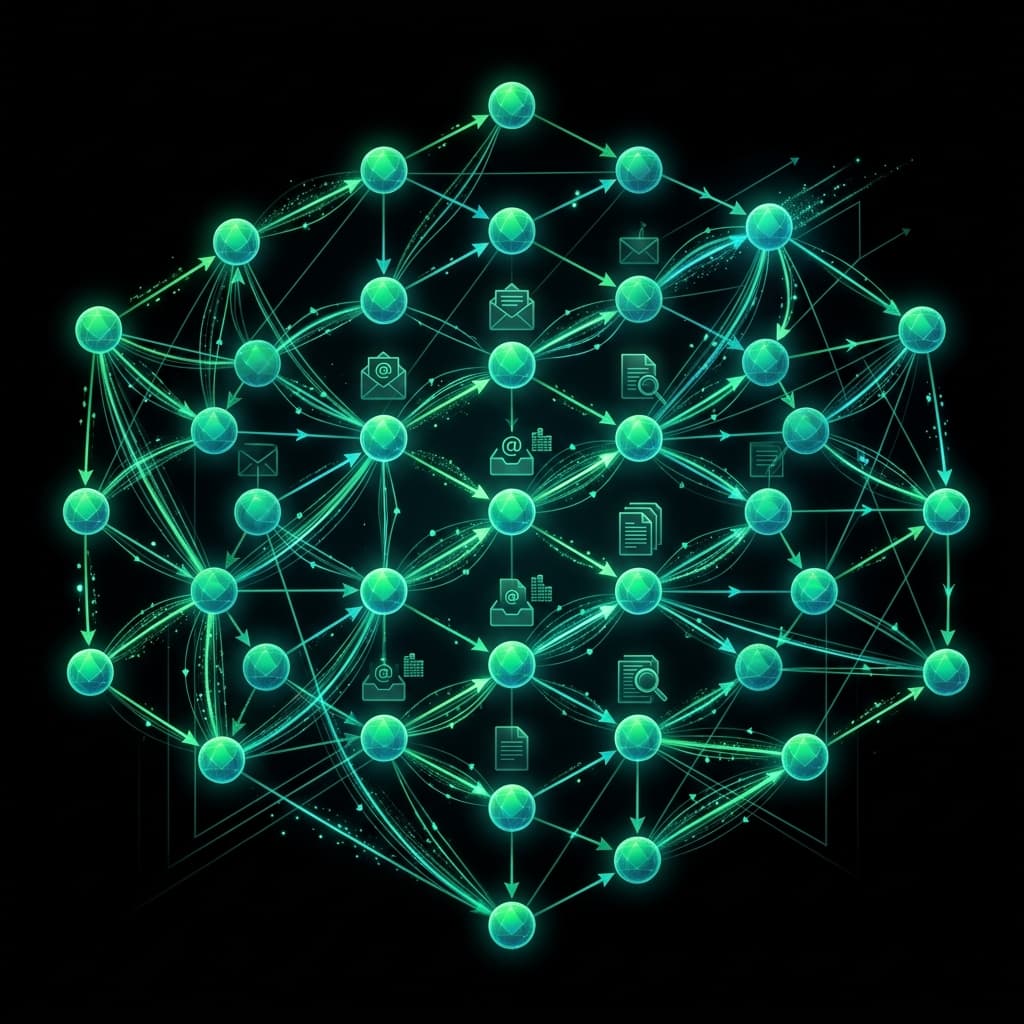
Most 'agents' fail because they are essentially just a loop with a prompt. For real-world business tasks—like researching 50 companies and writing personalized emails—you need orchestration, not just an agent.
In this guide, we'll explore why LangGraph is the current gold standard for building reliable, production-ready agentic systems.
#The Problem with 'Autonomous' Agents
Early AI agents (like AutoGPT) were designed to be fully autonomous. You gave them a goal, and they looped until they finished. In practice, this led to infinite loops, high costs, and low reliability. Production AI requires **constraints**.
#The State Graph Pattern
In LangGraph, we think in terms of a state graph. Each 'node' is a function, and each 'edge' is a transition. This allows us to build loops that actually have memory and can recover from errors.
Defining the State
The 'State' is the single source of truth for your agent. It is passed from node to node, and each node can update it. This is far more robust than just appending to a message list.
import { StateGraph } from "@langchain/langgraph";

// Define what the agent remembers across steps
const AgentState = {
  companyList: [],
  currentResearch: {},
  emailDrafts: [],
  status: "idle",
  errors: []
};#1. Persistence: The 'Save Game' for AI
One of the most powerful features of LangGraph is its built-in persistence layer. It automatically saves the state of your graph after every node execution.
#2. Parallel Node Execution
In a standard linear chain, if you need to research 5 companies, you do it one by one. In LangGraph, you can fan out. You can trigger 5 research nodes in parallel, and then use a 'Join' node to aggregate the results once they are all finished. This reduces total execution time from minutes to seconds.
#3. Multi-Agent Topologies
When tasks become complex, a single agent becomes overwhelmed. We split the work among specialized agents.
The Supervisor Pattern
One 'Manager' agent decides which 'Worker' agent should handle the current task. Once the worker finishes, it reports back to the manager. This is great for clear, hierarchical tasks.
The Network Pattern
Agents communicate directly with each other like a team. This is more flexible but requires careful design to avoid 'consensus loops'.
#4. Handling Edge Cases and Error Correction
What if the research tool returns a 404? What if the LLM produces invalid JSON? In a standard loop, the agent might just try the same failing action again. In a graph, we build specific 'Error Correction' nodes.
#5. Deployment with LangGraph Cloud
Scaling agentic workflows is difficult because they are stateful and long-running. LangGraph Cloud (and LangServe) provide the infrastructure to handle thousands of concurrent stateful sessions, providing a REST API for your graph with built-in streaming and monitoring.
#Conclusion
Building an agent is a weekend project. Building a multi-agent system that can handle 10,000 requests without hallucinating or looping is an engineering project. By moving to a graph-based architecture, you gain the control, observability, and reliability needed to ship AI that actually works.
"Moving from demo to production requires shifting focus from prompt engineering to system engineering. The magic is in the retrieval loop."